
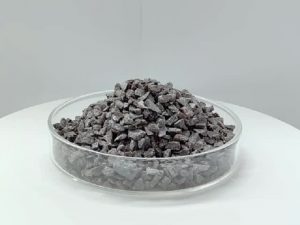
Iridium-coated brown fused alumina is a specially modified corundum material. Its production principle combines the preparation of brown fused alumina with surface iridium plating technology, aiming to improve the material’s performance in extreme environments (such as high-temperature oxidation resistance, chemical stability, and electrocatalytic activity). The following is a detailed analysis of its core production principle:
I. Preparation of the Brown Fused Alumina
Brown fused alumina is a type of alumina (Al₂O₃), produced from bauxite through high-temperature smelting:
Raw Material Processing: Bauxite is calcined to remove moisture and impurities.
Electric Arc Furnace Smelting: At temperatures above 2000℃, a carbon reducing agent (such as anthracite) and iron filings are added to reduce impurities (such as SiO₂, Fe₂O₃, etc.), generating a silicon-iron alloy precipitate that separates.
Cooling and Crystallization: After cooling, the molten liquid forms high-hardness brown fused alumina crystals (mainly α-Al₂O₃, containing small amounts of Ti and Fe oxides for color).
Crushing and Shaping: The blocky brown fused alumina is crushed and sieved into abrasive or matrix particles of the required size.
II. Principle of Iridium Coating Process
Iridium (Ir) is a high-density, high-melting-point (2466℃), corrosion-resistant platinum group metal. It is coated onto the surface of brown fused alumina using surface plating techniques. Common methods include:
1. Physical Vapor Deposition (PVD)
Principle: In a high-vacuum environment, the iridium target is vaporized by an electric arc or sputtering, and iridium atoms or ions are deposited on the surface of the brown fused alumina to form a film.
Characteristics: Uniform coating, strong adhesion, suitable for precision plating.
2. Chemical Vapor Deposition (CVD)
Principle: In a high-temperature reaction chamber, iridium precursor compounds (such as iridium trichloride (IrCl₃), iridium acetylacetonate, etc.) are reduced or decomposed, and iridium atoms are deposited on the substrate surface.
3. Electroplating or Chemical Plating
Principle: In an electrolyte containing iridium ions, iridium is deposited onto the surface of a conductive substrate using an electric current or a reducing agent. If brown fused alumina is non-conductive, a metallization pretreatment (such as coating a conductive layer) is required.
Characteristics: Lower cost, but the coating may be thinner.
III. Key Technical Points for Iridium-Plated Brown Fused Alumina
Surface Pretreatment:
The surface of brown fused alumina needs to be cleaned and activated. This may be achieved through acid pickling, ultrasonic cleaning, or roughening treatment to enhance adhesion.
Interfacial Bond Optimization:
Due to the significant difference in thermal expansion coefficients between iridium and Al₂O₃, a transition layer (such as W, Mo, or a gradient coating) is needed to alleviate stress and prevent peeling.
Coating Thickness Control:
The coating is typically in the micrometer range. Excessive thickness can lead to cracking, while insufficient thickness offers limited performance improvement.
Post-treatment:
Annealing may be performed to improve the crystallinity and bonding strength of the coating.
IV. Functions and Performance Enhancement of Iridium Plating
High-Temperature Oxidation Resistance: Iridium forms a dense oxide layer (IrO₂) at high temperatures, protecting the brown corundum substrate.
Chemical Inertness: Resistant to acid and alkali corrosion, suitable for highly corrosive environments.
Electrocatalytic Activity: Iridium is an excellent electrocatalyst and can be used in water electrolysis electrode materials.
Enhanced Wear Resistance: The high hardness of iridium further improves surface wear resistance.
V. Application Areas
Specialty Abrasives and Coatings: Used for precision machining or wear-resistant parts.
High-Temperature Electrode Materials: Such as electrolytic cell anodes, electrochemical catalysis.
Aerospace: High-temperature resistant coatings, propulsion system components.
Nuclear Industry: Radiation corrosion resistant materials.